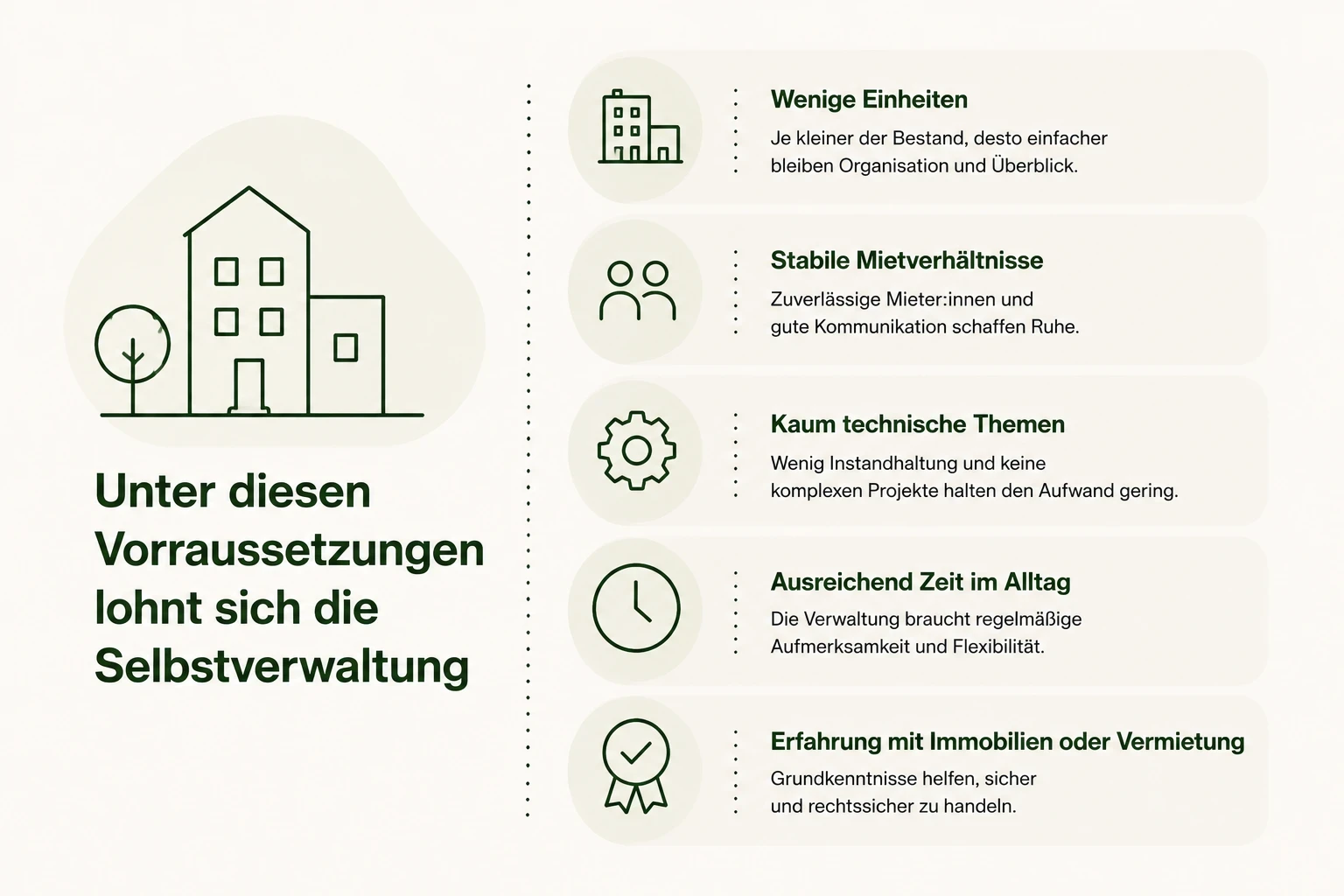
As long as a rental property is small, self-management often feels sensible. You know the tenants personally, minor issues are resolved directly, and you can sort most things without much coordination.
But this often changes gradually. First, you get occasional queries about the service charge billing. Then you have to coordinate contractors, check invoices, or fix damage. Over time, individual tasks turn into ongoing daily responsibilities.
At some point, the key question is no longer whether you can manage the property yourself. It is whether the effort is still a sensible use of your own time.
Why many owners manage their rental property themselves at first
Smaller rental properties in particular are often managed without an external property manager at first. This is understandable. If you only own a few units, you might live in the building yourself or have a short journey to the property.
A small rental property with four apartments, for example, does not automatically have to be managed externally. It usually only gets difficult when individual tasks turn into ongoing responsibilities and you can no longer organise things on the side.
The management workload often grows unnoticed
Most owners only realise late how much time actually goes into managing a rental property. That is because the workload rarely comes from one single large task. Usually, it is many small things at the same time:
Queries from tenants
Coordination with contractors
Invoices and documents
Service charge calculations
Handing over apartments
Insurance claims
Short-term repairs
With each additional unit, the organisational effort usually increases. On top of that, many issues cannot be planned. A heating breakdown, water damage, or a tenant moving out at short notice rarely happen when you actually have the time. Especially alongside a full-time job, management quickly becomes a second daily organisational routine.
When professional rental property management makes economic sense
Many owners initially view property management primarily as an extra cost. They often underestimate the economic value of their own time. A simple guide can therefore be:
If managing your rental property takes up more than 3 to 5 hours per week on a permanent basis, professional management is often already economically viable. This is because a few hours a week quickly turn into a significant effort.
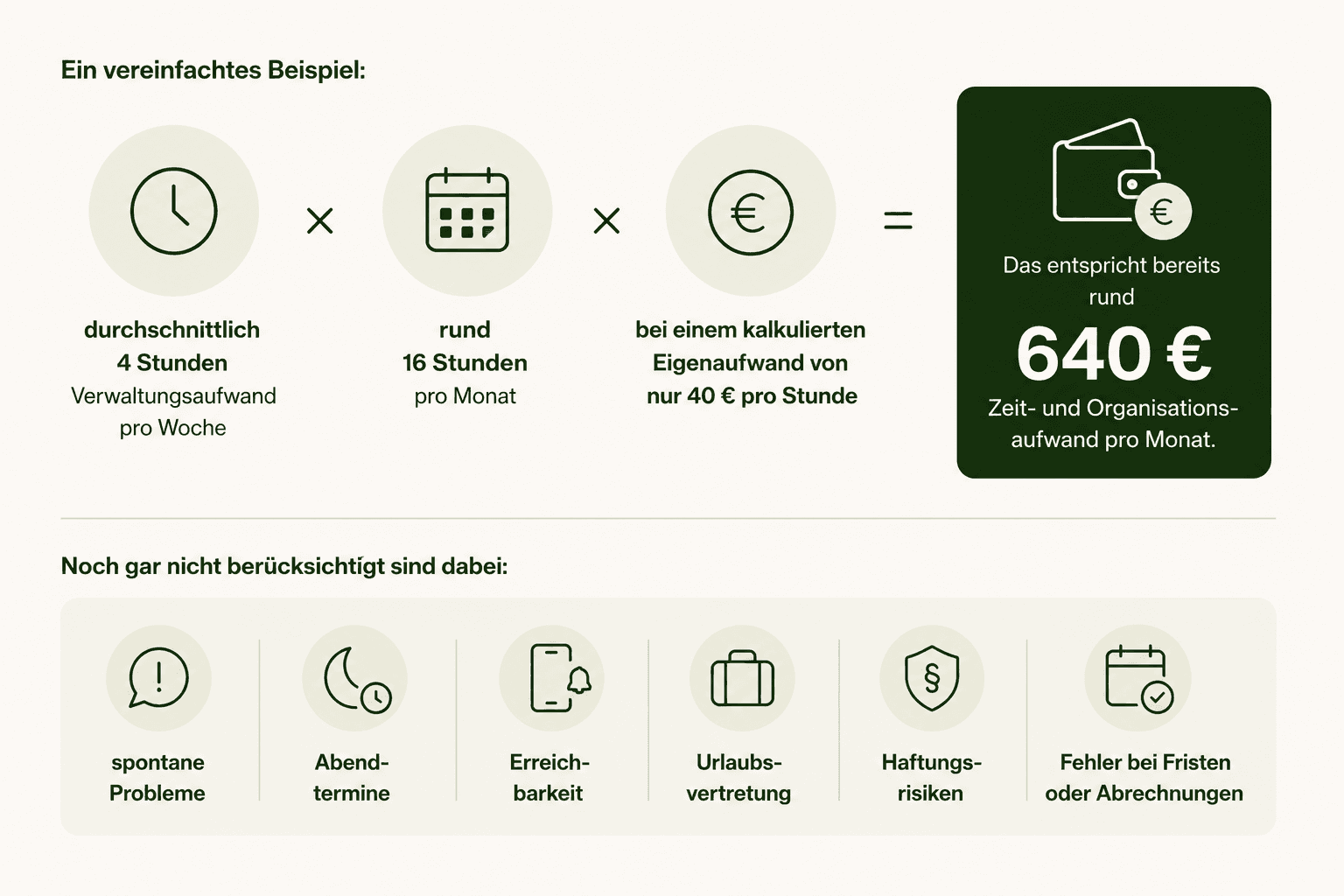
With 4 hours of management work per week and 16 hours per month, managing it yourself already equates to around £640 in time and organisational effort, assuming an internal rate of just £40 per hour.
Once a property reaches a certain size, management stops being a question of convenience and becomes an economic question of organisation.
The number of units is also decisive
However, it is also important to note that not every rental property automatically needs professional management. Very small properties with few units and a low management workload can certainly work long-term under self-management. This is especially true if you are close to the property and have enough time.
As the property size increases, however, the situation changes significantly. More units usually mean:
More communication
More coordination to do
More technical issues
More documentation
More organisational responsibility
From around 8 to 10 units, or when dealing with several parallel tasks, professional rental management becomes much more relevant for many owners. That is exactly when management starts to demand permanent oversight, availability, and reliable coordination.
What professional rental management actually takes off your shoulders
Many owners underestimate how much administrative work needs to be organised in the background on an ongoing basis. Everyday property management is about much more than just rental payments or individual repairs. Often, the individual task is not the problem. It is the fact that you constantly have to answer, coordinate, or follow up on something.
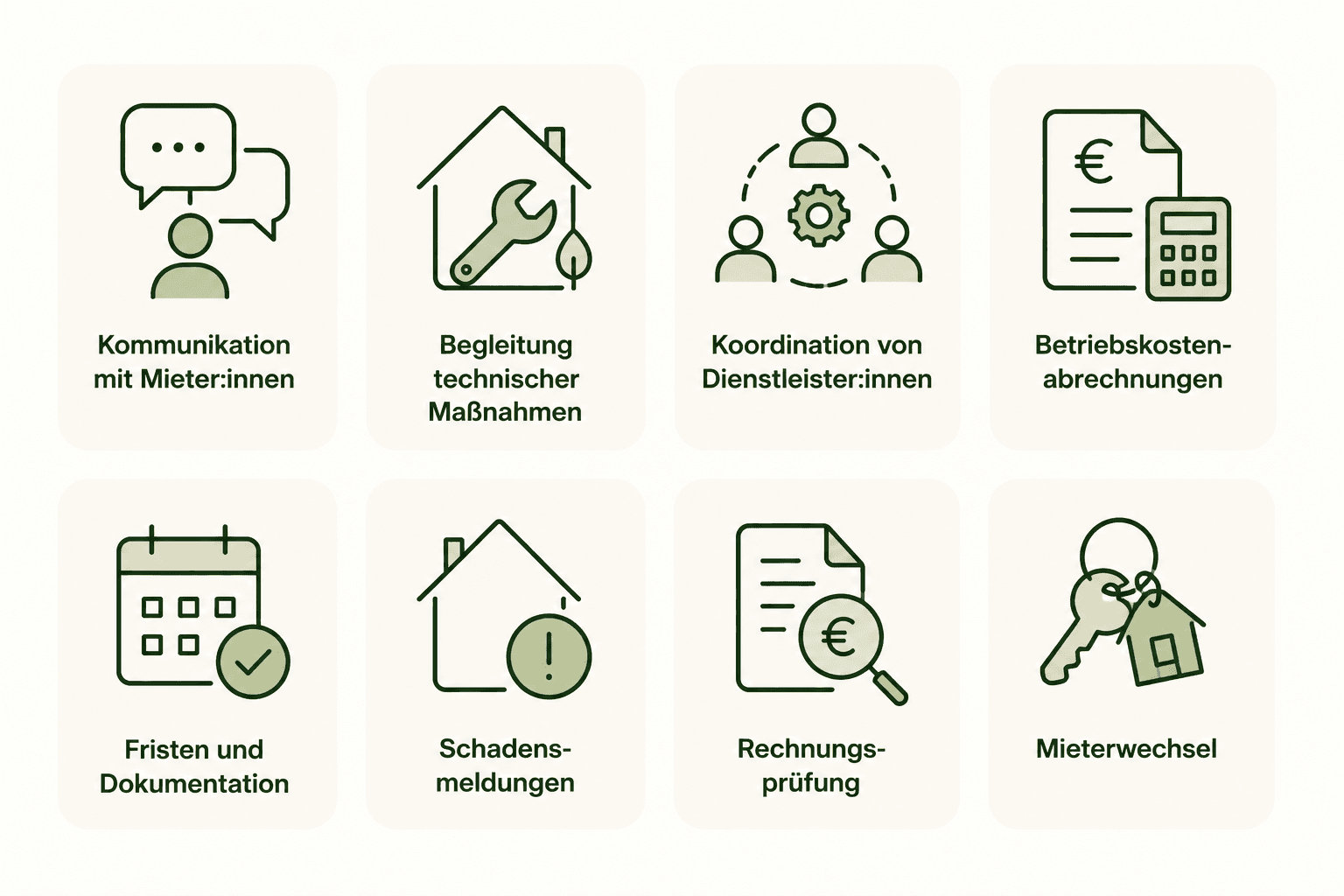
The administrative tasks are varied and altogether require a lot of time and organisation.
Good rental management does not take away your control over your property. Most of all, it handles the ongoing organisation in the background and ensures that issues are managed reliably.
The more important question is often not control, but effort
Many owners manage their rental property themselves at first because they want to keep an eye on everything. This is understandable. But control does not mean you have to do every task yourself forever.
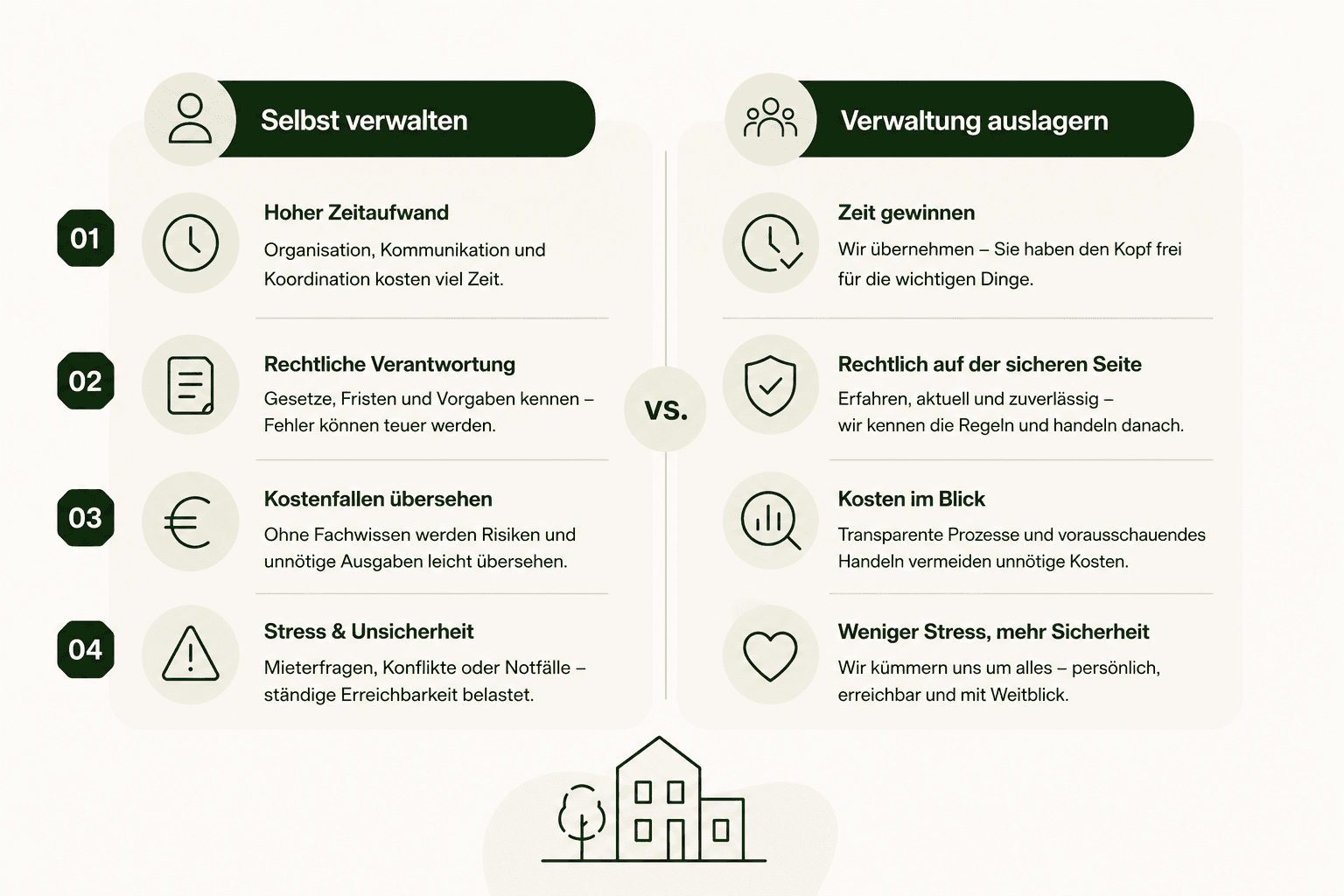
The advantages of outsourced management compared to self-management.
A much more critical question is often: how much time, availability, and organisational responsibility do you want to carry yourself in the long run? This is the point where professional management makes sense for many owners.
Good management brings peace of mind back to daily life
At Theo, we often see that owners only question self-management once the property is already taking up their time and attention constantly. It is rarely a question of whether you could manage it yourself in principle. It is about how much energy that requires in the long term.
Good rental management therefore ensures one thing above all: a clearer overview, more reliable processes, and less operational stress in your daily life. This means you do not have to spend your time dealing with admin tasks, but can manage your property in a relaxed, economically sensible way.
Find out why more and more people are switching to Theo.
Similar items
General
Insights and updates
Hallo theo is now Theo
hallo theo is now Theo. Three years ago, we started with a clear goal: to make property management reliable, straightforward and personal. That remains the same. What is changing is our brand. We have a new name, a new look and a new website. Your local team in Berlin, Frankfurt, Munich, Stuttgart and Wildeshausen is still here. Your contacts, phone numbers and email addresses also remain the same.
Homeowners' association
Insights and updates
New partnership: Theo and BSK Immobilien – estate agents for Berliner Sparkasse
As a property owner, you deal with a wide range of questions. Sometimes it is about daily management, sometimes a rental, selling a flat, or figuring out the current value of your property.
General
Market & outlook
New challenges demand new solutions: how property management needs to change
Property management is much more complex today than it was a few years ago. Owners expect fast replies, transparent processes and reliable contacts. At the same time, legal requirements are increasing, technical issues are becoming more demanding, and decisions within homeowners' associations must be properly documented and put into action.
Commercial
Security and value growth
Why property controlling determines your return.
The numbers look good, but too little is happening in the building itself? Maintenance is not managed consistently, measures are delayed, and technical issues are treated as an afterthought?