Some homeowners' associations (HOAs) run quietly and smoothly. Others find themselves discussing the exact same questions over and over: Who is looking after this? Who decides? What are the actual rules? And how can we prevent disagreements from escalating?
The difference often has very little to do with the building itself, and everything to do with how well the owners, the advisory board, and the property management team work together.
The good news is that you can improve many things with small steps, without having to reorganise the entire HOA.
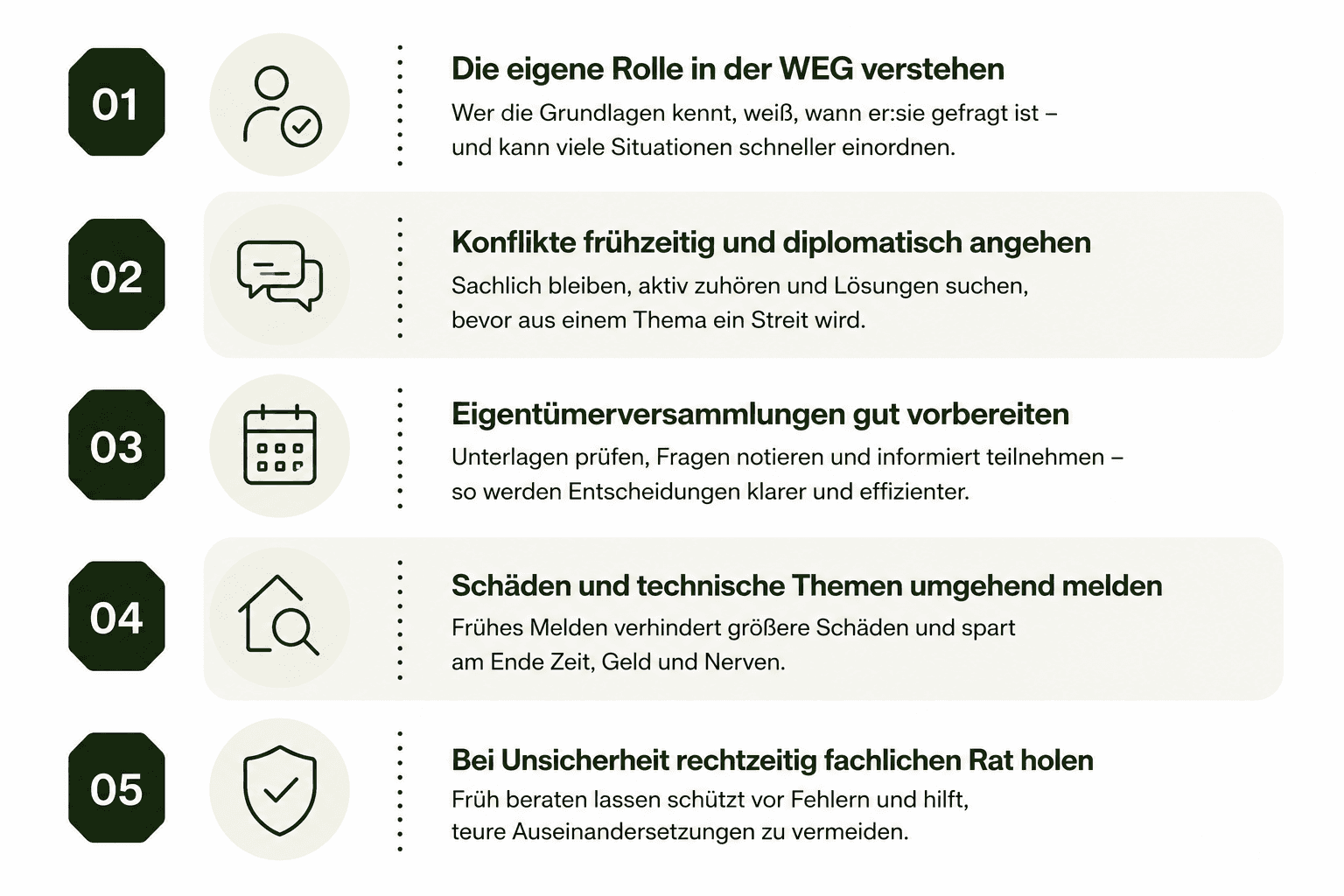
1. Understanding your role in the HOA
When you are part of an HOA, you do not just own a flat. You are automatically part of a community that needs to make joint decisions, bear costs, and follow rules. This is exactly why it helps to understand your role.
As an owner, you do not need to take on every operational task. However, you should know when your input is needed: during resolutions and votes, when damage occurs in your own unit, when sharing information with the property manager, or when making decisions at the annual owners' meeting.
Tip: Do not wait for a dispute to read the declaration of division, community regulations, and current resolutions. Knowing the basics helps you assess situations much faster.
2. Dealing with conflicts constructively before they grow
In an HOA, different interests naturally collide. Some owners live in the building themselves, while others let their flats out. Some want to invest quickly, whilst others want to keep costs as low as possible. This can easily create tension.
Not every conflict needs to end up in court. It often helps to raise issues early, objectively, and in writing. If discussions get stuck, a neutral third party or mediation can make sense before a dispute blocks the progress of the entire community.
Tip: Put difficult topics in writing, stay objective, and look for an out-of-court solution first. This usually saves time, money, and stress.
3. Preparing for annual owners' meetings
Most decisions in an HOA are made at the annual owners' meeting. When owners turn up unprepared, discussions can quickly become lengthy, emotional, or confusing.
It is much better to check the documents beforehand, write down any questions, and get informed about larger topics in good time. This is particularly important for maintenance, cost decisions, or structural changes.
Tip: Before the annual owners' meeting, check the agenda, quotes, budget plans, and proposed resolutions. This allows you to ask targeted questions and make informed votes.
4. Reporting damage and technical issues straight away
Minor damage often seems harmless at first. A damp patch on the facade, a broken door, or recurring faults in technical systems. In an HOA, however, these issues can quickly escalate if no one reports or tracks them properly.
With shared property in particular, it is crucial to document damage early and report it to the right person. This makes it easier to clarify quickly whether the management, the community, or individual owners need to take action.
Tip: Document damage with the date, photos, and a brief description. This helps the property manager or the advisory board react faster and assess the situation correctly.
5. Seeking professional advice early when unsure
Not every question in an HOA can be answered by gut instinct alone. If there is a dispute over shared property, cost allocation, resolutions, or rights and duties, it is wise to get advice early on.
You do not always have to go straight to a solicitor. Depending on the issue, consumer advice centres, homeowners' associations, local authorities, or mediators can help you assess the situation.
Tip: Seek advice before a conflict escalates. Getting an early assessment is usually cheaper and more helpful than a late dispute.
What good property management can do for you
Many improvements in an HOA start with small details: better preparation, clear communication, and a shared understanding of how decisions are made.
At the same time, you need a property manager working in the background to guide you reliably and provide clarity. At Theo, we see every day how much smooth processes can improve daily life within an HOA.
That is why we believe good management is not just about processing tasks. It is about taking the pressure off you before small issues turn into major problems.
Find out why more and more people are switching to Theo.
Similar items
General
Insights and updates
Hallo theo is now Theo
hallo theo is now Theo. Three years ago, we started with a clear goal: to make property management reliable, straightforward and personal. That remains the same. What is changing is our brand. We have a new name, a new look and a new website. Your local team in Berlin, Frankfurt, Munich, Stuttgart and Wildeshausen is still here. Your contacts, phone numbers and email addresses also remain the same.
Homeowners' association
Insights and updates
New partnership: Theo and BSK Immobilien – estate agents for Berliner Sparkasse
As a property owner, you deal with a wide range of questions. Sometimes it is about daily management, sometimes a rental, selling a flat, or figuring out the current value of your property.
General
Market & outlook
New challenges demand new solutions: how property management needs to change
Property management is much more complex today than it was a few years ago. Owners expect fast replies, transparent processes and reliable contacts. At the same time, legal requirements are increasing, technical issues are becoming more demanding, and decisions within homeowners' associations must be properly documented and put into action.
Commercial
Security and value growth
Why property controlling determines your return.
The numbers look good, but too little is happening in the building itself? Maintenance is not managed consistently, measures are delayed, and technical issues are treated as an afterthought?